
What Jigsaw Puzzles Teach You: How the Search Becomes the Answer
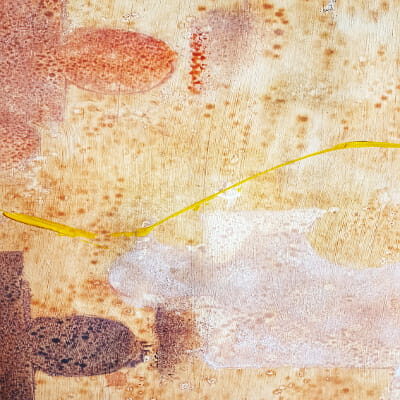
The third painting in the ‘Still Missing One Piece’ abstract art series.
This is Part 3 of the Still Missing One Piece abstract painting series, a collection of paintings. Each one is a separate story, the same ongoing search.
If you’re new here, you might enjoy starting with Part 1: Missing Puzzle Piece: An Abstract Art Jigsaw Story We All Know and Part 2: Jigsaw Puzzle Psychology: Why Some Pieces Stay With Us Forever. These blog posts will make this post richer and more meaningful.
If you’ve been here from the beginning, welcome back. This one, as promised, goes somewhere a little more hopeful.
The Moment the Search Changes
There is a particular moment that most dedicated jigsaw puzzle enthusiasts will recognise, though it almost never gets talked about, possibly because it sounds slightly odd when you try to explain it to someone who does not do puzzles.
It happens somewhere in the middle of a large, demanding puzzle, the kind you probably should not have bought but absolutely do not regret. The early excitement of tipping out the pieces and finding the corners has long settled. The straightforward sections are done. You’re now deep in the difficult territory. Sky, almost certainly or water, or that enormous section of autumn leaves where every single piece looks identical until it suddenly, inexplicably, does not.
Every piece you try looks almost right. None of them is. You have been looking for the same piece for longer than you would like to admit and considerably longer than you would admit to anyone else.
And then, quietly, without announcement, something shifts.
Not the puzzle. You.
Somewhere in the patient, repetitive, almost meditative act of searching, the frustration loosens its grip. You stop fighting the difficulty and start simply, being there. Present. Absorbed. Oddly at home in the act of looking itself. The missing piece still matters. But so does this moment, right now, at the table. The searching has become its own quiet reward.
Most people dismiss this feeling when it passes and go back to hunting for the piece. But what if this moment, this small, overlooked shift, is actually the most valuable thing a jigsaw puzzle can give you?
What Jigsaw Puzzle Teach You That Nothing Else Quite Can?
Jigsaw puzzles are unusual among hobbies in one specific way. They’re simultaneously about a destination and a journey, and the two are inseparable. You cannot rush to the end without doing the middle. You cannot skip the searching. Every piece must be found, handled, considered and placed in its own time, in its own order.
This makes what jigsaw puzzles teach you fundamentally different from what most goal-orientated activities teach.
They teach you that attention is its own reward.
In a world that constantly accelerates, notifications, deadlines, the pressure to produce and perform, a jigsaw puzzle asks you to slow down and look carefully at something small. To hold a piece and really see it. To notice the precise curve of an edge, the exact shade of a colour, the particular way the light falls on a section of the image.
This quality attention, unhurried, detailed, patient, is increasingly rare. And puzzles remind you, quietly and without lecturing, that it’s also deeply satisfying.
They teach you that not all progress is visible.
There are stretches in any large puzzle where you work for a long time and the overall picture barely seems to change. Ten pieces placed and the image looks almost identical to before. This is genuinely useful knowledge for life, that meaningful work often happens in stages too small to see in the moment and that persistence through invisible progress is a skill worth developing.
What jigsaw puzzles teach you here is patience without passivity. You’re still moving. It simply does not look like it yet.
They teach you something important about searching itself.
This, perhaps, the deepest lesson. When you search for a missing piece, really search, with full attention and without rushing, you notice things you would otherwise have missed. Places you were not looking for suddenly become visible. Connections you had not considered reveal themselves. The act of searching, done with genuine openness, almost always gives you more than you were originally looking for.
This is true at the puzzle table. It is also, if you allow it to be, true everywhere else.
The Question Behind the Search
In Part 1 of this series, we sat with the feeling of a missing piece. That quiet, personal discomfort of something incomplete.
In Part 2, we explored the psychology of why we hold on. Why certain pieces, at the table and in life, refuse to leave our minds even long after logic suggests they should.
This post promised something different. More hopeful. And here it is.
What if the missing piece was never only about what we lost? What if it was also, always, about what the searching itself was making us into?
I know this is not easy to explain, but here we go.
Every time we look carefully for something we cannot immediately find, we’re practising something. Patience. Attention. The willingness to sit with incompleteness without being defeated by it. The capacity to keep going in the absence of certainty. These are not small things. They’re, in many ways, the qualities that make a life feel well-lived.
What jigsaw puzzles teach you, at their deepest level, is this: the search is not a detour on the way to the answer. The search is the answer. It is where the important things happen. It is where you find out who you are.
Still Missing One Piece No. 3 – The Painting

This is the third painting in the Still Missing One Piece series. And it feels, from the moment you look at it, like a breath of open air after the intimate weight of the first two.
It’s the same format as its predecessors. Portrait-orientated archival card 42 x 59.4 cm (16.5 x 23.4“), and the same characteristic powdery, matte surface unifies it with the series. But the emotional atmosphere here is noticeably different. Lighter. More spacious. As if something has shifted between the second painting and this one.
The background is the palest the series has offered, somewhere between soft white and warm light grey with a slight pearly warmth that keeps it from feeling cold or clinical.
It’s the colour of early morning light through thin curtains. Open, quiet and full of an unspecified possibility. Very faint tonal variations move across the surface, the kind only visible when you look closely, giving the surface a gentle atmospheric depth without imposing any shape or pattern. It breathes.
Four jigsaw pieces are distributed across the upper and middle areas of the canvas and their arrangement is unlike anything in the first two paintings. They are not clustered. They are not touching. They do not interlock. Each one is separate, isolated in space and each is gently tilted at its own slight angle, as if caught mid-turn, min-consideration, mid-journey.
Together they form a loose diagonal flow across the composition, from upper left to lower right, that gives the painting a quiet sense of movement. Not urgency. Movement.
The upper left piece is warm sand, beige-ochre, slightly deeper than the background, clearly present. Its surface is gently shaded, with a slightly darker concentration toward the centre softening outward toward its feathered edges.
The upper right piece is the familiar pale grey-blue of the series, cooler, the strongest temperature contrast in the painting. Delicate but grounded.
Below and to the centre sits a soft cream piece, so close in tone to the background that its edges partially dissolve into the surrounding surface, present, but only just. As if it’s still deciding whether to appear. So faint it nearly merges with the canvas entirely, visible only with patient attention. Almost dissolved. Almost background. And yet there.
And in the middle left is the darkest. Making its presence known. Saying something louder than the other pieces, but why?
Four pieces. None together. All searching.
Running through the composition is the gold thread and here, in this third painting, it’s the most expressive it has been in the series. It begins near the left edge and continues across to the other edge. A wave path, not touching any of the pieces as it travels. Just close enough to three pieces but not the fourth piece, why?.
The line is delicate, the same warm gold as in Posts 1 and 2, but more purposeful.
It still carries the slight variations in thickness, the small interruptions, the places where the pigment briefly thins. It’s the same thread. But now it knows where it’s going.
It doesn’t connect the pieces. It moves between them, near them, around them. It’s not a solution. It is a path.
This painting came from the realisation that searching isn’t a state of failure. It’s a state of motion. The pieces in this painting are not lost. They’re simply not yet where they belong. And the golden thread running between them isn’t waiting for them to arrive. It’s already tracing the route.
Something to Carry With You
The next time you sit down with a jigsaw puzzle, try shifting your attention. Just once, just briefly, away from the goal of completion and toward the experience of searching.
Notice what the search actually feels like when you stop fighting it. Notice the quality of attention it requires. Notice how, in the act of looking carefully for one specific piece, you begin to see the others more clearly.
And if you’re willing to take it one step further, ask yourself what this particular quality of attention might look like in another part of your life. Not the frustration of the missing piece, but the patience of the search. The willingness to keep looking, to stay present, in trust that the right connection will reveal itself in its own time.
What jigsaw puzzles teach you, when you let them, goes well beyond puzzles.

The Search Continues
Three paintings. Three different moments in the same ongoing story. A piece almost connecting. An impression left behind. And now, four pieces in motion, a thread between them, open space ahead.
The series is not finished. Neither is the search. But something has shifted here, in this third painting, that feels important. The space around the pieces is no longer heavy with absence. It is light with possibility.
I’d like to know, has there been a moment at the puzzle table when the search itself became the point for you?
When did looking matter as much as the finding?
Part four of this series takes us somewhere unexpected. Not searching, not finding, but learning to live beautifully with the gap. It’s, perhaps, the most honest post in the series.
I hope you’ll come back for it.
A note from the author:
This post asks some questions that go beyond jigsaw puzzles. Questions about what we search for, what we hold onto and what we are really looking for beneath the surface of everyday life. For most readers, these will be gentle and reflective questions. But for some, they may touch something deeper and more tender. If that is the case for you, please be kind to yourself. Sit with whatever arises at your own pace. And if you find yourself carrying something heavy, please consider speaking with someone qualified to help you carry it.


22 March 2026 @ 4:21 pm
Another great blog post, Suhail!
I especially like the feeling after working on a puzzle for a time when I start to pick up new pieces and know instinctively where that piece belongs based on color and/or size. It is much like an ah-ha moment. It is like I am becoming one with the puzzle and knowing how it all fits together.
One other thing I especially like when building puzzles is the final stretch when there are only a few pieces left and one can pick up each piece, one at a time, and quickly place them without much additional thought. I imagine it is like running the last hundred yards of a marathon, when one’s body is firing on all cylinders, the mental high is at its peak, the whole world outside goes quiet, and the slow-motion visuals bring the end in sight and finally across the finish line. “Chariots of Fire” comes to mind.
As a challenge to myself, I will sometimes approach making the puzzle in different ways. Of course, there is the traditional – finding the edges first, completing the easy sections, and then working at the more difficult areas, as you said. Other times I start with the difficult areas and work backwards from the traditional method. Other times, I work upside down, at least for a good portion of the puzzle.
The concentration required by doing a puzzle seems much to me like practicing Zen philosophies. It requires that one focuses on the act – doing only that single act without distractions from outside influences. When eating, eat; when singing, sing; when puzzling, puzzle.
The Question Behind the Search – I like this bit a lot – it made me see that puzzling, like life, is about the journey, not so much the destination. That said, arriving at the destination is cathartic, at least in part – if the journey was physically or emotionally draining. What is important is what we learned or felt along the way.
I liked how you touched on many of the things I thought about before reading past the first section.
As always, I enjoyed your depth of thought, and your art.
Just for fun, I downloaded your 3 images and placed them side by side in order from 1 to 3. I will add the fourth image when you upload the next blog post. I was curious to see if they would tell an additional story when placed as such. I am not sure at this point but will see after the fourth is placed. Have you done that in your studio? Maybe in the next post you can indicate if you have and what you saw as a whole series, although you may have already said that ay the beginning of the series.
23 March 2026 @ 12:49 pm
Thank you so much, Don.
You’ve brought so much of your own experience and thought to this post that reading your comment felt like a conversation rather than a response. And a conversation I very much enjoyed.
Your description of that instinctive moment, picking up a piece and knowing immediately where it belongs, is something I recognise well. That ah-ha moment you describe is not just satisfying, it’s a brief and beautiful experience of complete coherence. Of knowing, without having to think, how something fits into a larger whole. Those moments are rare in daily life.
And the final stretch. Your description of those last few pieces stopped me completely. The comparison to the last hundred yards of a marathon, the world going quiet, the slow-motion clarity of the finish line approaching, that is one of the most precise and evocative descriptions of that particular feeling I have encountered. Chariots of Fire is exactly right. There is something almost ceremonial about placing those final pieces. Something that deserves its own music.
Now, your final paragraph.
You placed the three paintings side by side. You felt something but could not yet see it clearly. And you are waiting for the fourth before deciding what the series as a whole is saying.
I have to tell you — I did exactly the same thing. I placed all four paintings side by side in my studio, out of curiosity, the same feeling that something was there just beyond reach. And I could not see it clearly at first. I was too close to the paintings. Too close to the missing piece.
It took a different light and a little distance, before I could see what the paintings were saying together.
Post 5 will address this directly, what I eventually saw when I looked at all four paintings together, and why it took the distance of time and a different quality of light before the journey they describe became visible to me.
It would be interesting to know what you see when you add the fourth painting and see them together.
Thank you for puzzling alongside this series with such generosity and depth of thought.
23 March 2026 @ 3:19 pm
Thank you for the wonderful reply!
I am definitely looking forward to part 4 and 5!
Best wishes!