
Still Missing One Jigsaw Piece – What I Could Not See Until Now
I finished the fourth painting. I wrote the fourth post. All bout the ‘Still Missing One Piece’ abstract painting series. Then, out of curiosity, I placed all four paintings side by side.
I wanted to see whether, together, they hold a different story. Another journey. Something I hadn’t intended, but which had emerged anyway across the four canvases.
I looked for a long time.
And I couldn’t see it.
I couldn’t quite read the story the paintings were telling together. I kept moving my eyes from left to right, from the first canvas to the last and nothing fully came into focus. I felt it, but I couldn’t quite reach it.
The reason, I think, is simple. I was too close to the paintings. Too close to the missing piece.
The Journey of Still Missing One Piece
I wasn’t looking for the still missing one jigsaw piece. I was looking for another possible story.
When you’re inside something, really inside it, the way you’re inside your own memories, your own losses, your own unresolved things, you can’t always see its shape. You can feel it. But seeing it clearly often needs distance. And distance is one thing you can’t have from your own life.
But time is distance, too.
As an artist, I have long had a habit of living with a painting after I finish it. I place it somewhere I will see it often, then wait.
I’ve learned that light changes everything. Bright daylight is honest and unsparing. Evening light is softer. Lamp light, late at night, can reveal something that wasn’t visible before. Sometimes a painting doesn’t speak until the room is quiet enough to hear it.
I had placed these four paintings side by side in exactly that spirit. I knew they were saying something. I could feel it. But I couldn’t yet see it.
Sometimes the painting needs a different light. Sometimes the painter does.
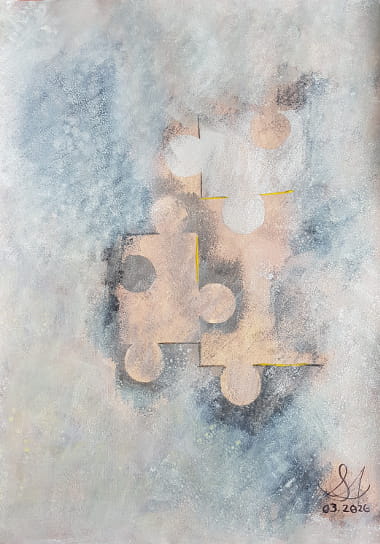
Painting 1 – Almost
The first painting in the ‘Still Missing One Piece’ series is about hope.
A cluster of pieces settled together. One piece sitting slightly apart, close enough to matter, almost touching, but not quite there. A delicate gold thread, broken in places. Everything in this painting leans towards connection.
The word underneath everything in this first painting is almost.
Almost whole. Almost there. Almost home.
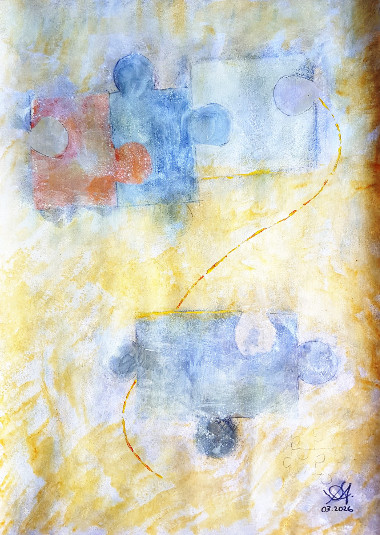
Painting 2 – Gone, But Not Forgotten
The second painting is where ‘almost’ ends.
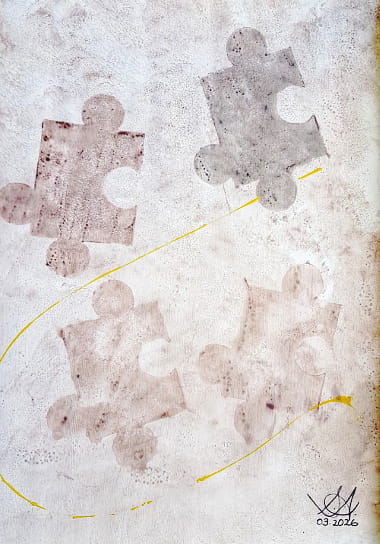
The piece is no longer close. It’s absent. Three pieces sit together in the upper part of the canvas, complete among themselves. Below them lies a ghost: the impression of a piece pressed into the surface. Pale. Semi-transparent. Slightly rough where everything else is smooth.
Something was here. It’s no longer here. But the surface remembers exactly where it was.
This painting knows that absence isn’t complete. A gap can hold the shape of what it lost.
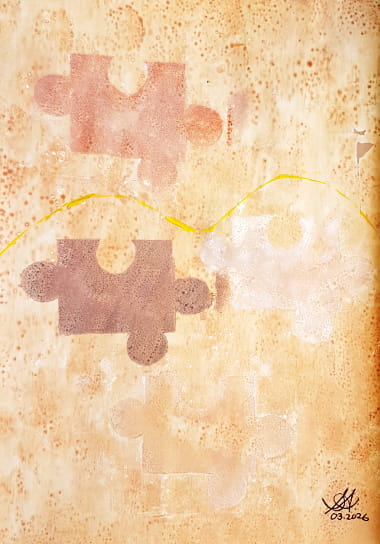
Painting 3 – Searching
By the third painting, something has shifted.
The canvas feels lighter. More open. Four pieces are dispersed across the surface, none touching, none clustered, each one gently tilted at its own angle, as if caught mid-journey. Not lost. Not found. Simply in motion.
And the gold thread sweeps across the canvas in a loose arc, passing near the pieces without touching them. It’s still searching, but with more confidence than before.
This painting taught me that searching is not failure. That being in motion, even without a destination, is its own kind of wholeness.
Painting 4 – Here
The fourth painting is the quietest thing I’ve made in a long time.
A soft, cool grey background, slightly deeper at the edges, gently luminous in the centre. Four jigsaw pieces in a loose arrangement, not clustered, not drifting, but settled. Each one is present. Each one is at a quiet distance from the others.
The surface carries a barely perceptible variation in texture, as though the space has been returned to many times. Lived with. Made familiar.
And the gold thread, for the first time across all four paintings, is unbroken.
It doesn’t force the pieces together. It simply moves through the composition, near each one, continuous and unhurried. Holding everything together without forcing anything together.
The lower light piece is the lightest. Faint, but not gone. It’s still there. Patient. At peace with where it is.
The missing jigsaw piece is still missing.
The fourth painting doesn’t resolve the series. It doesn’t bring the piece home. What it does or what I hope it does is show what it looks like to carry the missing piece gently, until it becomes part of the background of your life rather than a wound at its centre.
What I See Now
Looking at all four paintings together, I can now see what I couldn’t see when I was standing too close.
The light changes across the series. From the warm pale grey of the first painting to the cooler grey of the fourth, the atmosphere shifts slowly, like a life learning how to carry something difficult without being shaped entirely by it.
The gold thread changes, too. Broken. Searching. Restored.
The missing piece becomes quieter across the series. Almost connecting in the first painting. An impression in the second. A ghost in the third. Faintly visible in the fourth. Not gone, but gradually moving into the background.
And the sharp edges soften as the series progresses. The jigsaw shape remains what it is, but it begins to sit more naturally inside my own visual language.
I didn’t see any of this while I was making the paintings. I was too close. But standing back, I can see it now.
Four paintings. One journey.
Almost, Gone, but not forgotten. Searching. Here.
Not a journey towards finding the missing jigsaw piece.
A journey towards being at peace with its distance – time.
Creating the series
Making these paintings was hard in a way I hadn’t expected.
I’m a non-representational abstract artist. My usual language is organic, felt and inspired by nature. This series asked me to work with something very different: the jigsaw piece, one of the most engineered shapes imaginable.
Every tab and socket is precise. Every curve is deliberate. It’s a man-made shape in the purest sense. That meant I had to work in a way that didn’t come naturally to me. I had to accept a different kind of order and let that tension become part of the work.
That wasn’t easy. But in the end, the tension between the geometric shape and my own instinctive language became a conversation rather than a conflict.
I also struggled to photograph the paintings accurately. The grey tones in the originals sit carefully between warm and cool, but the images tend to read bluer than they really are.
If you ever see the paintings in person, in changing light, they will speak differently. More quietly. More truly.
Writing the Series
Writing this series felt like doing a jigsaw puzzle.
There were moments of not knowing where the next piece belonged. Moments of stepping back and returning with fresher eyes. Moments of sitting with the discomfort of something unfinished.
But perhaps that was always part of the work.
The four paintings series are waiting for you in the links below. Each post stands alone. But the journey is richer when travelled in full.
Part 1: Missing Puzzle Piece: An Abstract Art Jigsaw Story We All Know
Part 2: Jigsaw Puzzle Psychology: Why Some Pieces Stay With Us Forever
Part 3: What Jigsaw Puzzles Teach You: How the Search Becomes the Answer
Part 4: Jigsaw Puzzle and Mindfulness: Learning to Live Beautifully With the Gap


31 March 2026 @ 11:40 pm
A beautiful conclusion to the series, Suhail!
“A journey towards being at peace with its distance – time” spoke volumes to me and I felt your experience through your skilled thought-filled writing.
Thank you for sharing your journey – it makes your lovely art so much more meaningful.
2 April 2026 @ 9:20 am
Thank you so much, Don, for your kind words.
I’m really glad that line resonated with you and that the piece could convey something of the experience behind it. It means a lot to know the writing adds another layer to the work. I truly appreciate you taking the time to share your thoughts.