
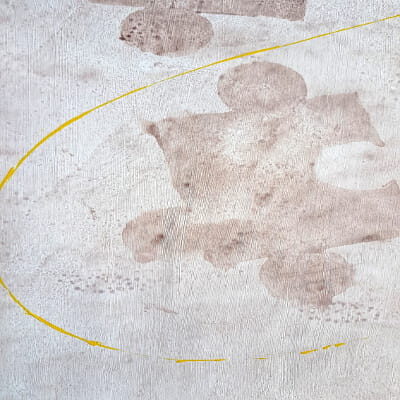
Jigsaw Puzzle and Mindfulness: Learning to Live Beautifully with the Gap
The fourth and final painting in the ‘Still Missing One Piece’ abstract art series.
This is part 4, the final post, of the Still Missing One Piece abstract painting series. If you’re new here, welcome. You might enjoy starting from the beginning:
Part 1: Missing Puzzle Piece: An Abstract Art Jigsaw Story We All Know,
Part 2: Jigsaw Puzzle Psychology: Why Some Pieces Stay With Us Forever,
Part 3: What Jigsaw Puzzles Teach You: How the Search Becomes the Answer.
If you’ve been here from the start – thank you.
The Puzzle That Became Part of the Room
You know how it happens.
The puzzle has been on the table for days or maybe weeks. You stopped counting exactly when. At some point, family members stopped asking about it. The cat stopped sitting on it, mostly. It has earned its place. It’s simply there now, part of the furniture, part of the daily landscape of the house.
The gap is still there, too.
That one missing piece never turned up. You’ve long since accepted that it’s not going to.
And here’s the thing. Somewhere along the way, without you quite noticing when, the gap stopped bothering you.
You walk past the puzzle now and glance at it the way you glance at a favourite photograph on the wall. With familiarity. With a kind of quiet affection. The puzzle is unfinished. You’ve made your peace with that.
When did that happen? And what does it mean that it did?
What Jigsaw Puzzle and Mindfulness Have in Common?
Most people think mindfulness means achieving a calm, clear, perfect state of mind. I don’t think it only does that.
I think mindfulness means being fully present with things exactly as they are. The complete and the incomplete. The resolved and the unresolved. The found and the still-missing.
A jigsaw puzzle with a gap, left on the table and accepted, that is a small, quiet act of mindfulness. You’re choosing presence over perfection. That’s not a small thing.
The gap teaches acceptance. In mindfulness practice, one of the hardest lessons is this: not everything can be fixed. Not everything can be finished. The unfinished puzzle is a gentle, low-stakes way of practising exactly that lesson. Every time you walk past the gap without frustration, you are building a genuinely valuable mental muscle. Slowly. Quietly. Without even trying.
The process matters more than the ending. Research into jigsaw puzzles and wellbeing shows something consistent and important. The mental health benefits of puzzling come from the doing, not the finishing. The absorption. The focus. The gentle, meditative quiet of it. Think about it, these happen throughout the puzzle, not just at the end. Completion is the bonus. The journey is where the real value lives.
The gap is part of the picture. This is the most important point of all. A puzzle with one piece missing is not a failed puzzle. It’s a puzzle almost complete. Almost is not nothing. Almost is, in fact, most of everything – think about it. The gap doesn’t cancel what surrounds it. It simply exists alongside it.
Learning to see the gap as part of the picture, rather than a flaw in it, is where jigsaw puzzles and mindfulness genuinely meet.
What Nature Know That We Sometimes Forget?
Nature doesn’t do straight lines.
It doesn’t do perfect circles. It doesn’t do neat, symmetrical, engineered shapes. A river curves and doubles back on itself. A tree leans toward the light at its own particular angle. A coastline is jagged, irregular and entirely breathtakingly beautiful.
We do not love nature despite its imperfection. We love it because of it.
There’s something in us that knows this. We spend our working lives surrounded by man-made straight lines. Screens, buildings, roads, spreadsheets (and let’s not forget mobile phones), everything rectangular, everything measured, everything exactly as intended. And then we go to the coast, or the woods, or simply look up at an uneven sky, and something in us exhales. (That’s simply what I find in creating abstract art.)
The jigsaw piece is perhaps one of the most engineered shapes imaginable. Every tab and socket is precisely calculated. Every curve deliberate. Every piece is designed to fit exactly one place and no other. It’s the opposite of nature.
And yet, when one piece is missing, the puzzle becomes, in a small way, more like nature. Imperfect. Irregular. Incomplete. And strangely, honestly, more human for it.
What if the gap is not the problem? What if the gap is simply where the light gets in?
Still Missing One Piece No. 4 – The Painting

This is the fourth and final painting in the series. It feels different from the moment you look at it.
Something has settled here.
The canvas is portrait-orientated, the same archival card as the previous paintings, the same smooth, matte, powdery finish that has unified the series throughout. But the atmosphere is more luminous than anything that came before.
The background is soft, warm grey, the colour of old paper held gently up to afternoon light. Slightly deeper toward the outer edges, gradually lighter toward the centre, where the surface carries a very faint circular glow. Not sharp, not dramatic. Just a quiet lightning at the heart of the composition. As if the canvas is breathing warmth outward from within.
Four jigsaw pieces are placed across the canvas. They’re not connected. They’re not touching. But they’re not searching either. Each one simply occupies its own space – present, settled, at a quiet distance from the other.
The upper piece sits above the centre, slightly left of the midline. It’s warm grey, slightly deeper and more saturated than the background, but entirely of the same family. Its edges are clear and visible. The outlines are almost solid. It sits with complete stillness.
The upper right piece sits confidently in its space. It’s the darkest piece, the newest and latest arrival in the space. The edges are clear, the centre is almost solid. It announces itself. It’s asking to be seen.
The lower left piece is a muted grey-lavender, the cool accent of this painting. Perhaps it has been gently influenced by the warmth of the upper piece, shifting toward lavender rather than the purer blue-grey of the earlier paintings. It’s rotated slightly off upright, naturally, informally, as if it found its own angle and rested there. Its edges are clear, its centre marginally lighter.
Then there is the fourth piece.
It sits in the lower right of the canvas. It’s lighter than all the other pieces.
It’s the most dissolved piece. Not totally dissolved. Not absent. But faint, so close in tone to the background. It’s still a clear, obvious shape. It’s still a jigsaw piece. It doesn’t announce itself. It doesn’t ask to be seen. An yet, once you have seen it, you cannot unsee it. It has been here long enough to become almost part of the surface itself.
It needs a patient look. But it’s there, gently rotated, quietly present, asking nothing.
This piece carries a particular meaning that the other three do not. The upper left piece is quiet but visible. The upper right piece is present and settled. The grey-lavender piece is recognised and at rest.
But this fourth piece, hovering at the edge of perception, neither fully present nor fully gone, is the one the series has always been about.
It is the piece that is still missing.
Not lost. Not found. Simply, still out there. Faint. Patient. Waiting in the warmth of the background for the moment someone looks closely enough to find it.
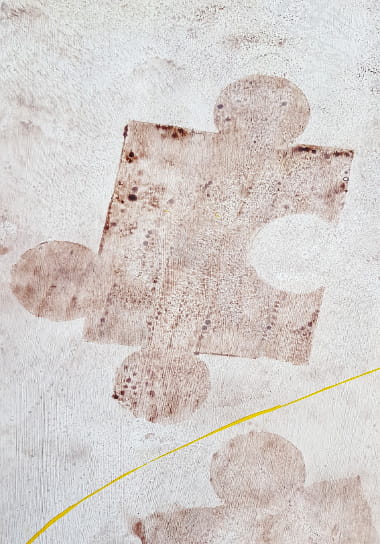
In every painting in this series, there has been a missing piece, a ghost, a trace of something not yet resolved.
In Post 1, it was almost connected.
In Post 2, it left an impression.
In Post 3, it was in motion.
Here, in the final painting, it is still present, but quieter than it has ever been. As if it too has made a kind of peace with where it is.
That’s perhaps the most honest thing this painting says. The missing piece doesn’t always come home. But it doesn’t disappear either, very faintly, very gently, part of the picture.
Running through the composition is the gold thread, and here, for the first time in the series, it is almost unbroken.
It begins near the lower right piece, touching it in two places as it continues its journey and circles around the lavender-grey lower left piece without touching it. The curve travels outside the space into an unknown space and time, only to enter its origin space again, passing through the upper left piece before continuing toward the upper right piece.
The line slightly changes its thickness as time changes. It’s smooth and follows its own path, organic, unhurried and almost continuous.
The same thread that was delicate but broken into clear pieces in Post 1. Darker but fragile in Post 2. Continuous from edge to edge in Post 3. Here, it simply holds.
And somewhere in the canvas, the fourth piece waits. Faint. Still. Still missing one piece.
The entire space on the canvas is light, open and still breathing.
This painting did not come easily. None of them did. But this one, perhaps, asked for the most patience, because it needed me to paint not drama or tension or searching, but decades of a missing piece.
The particular warmth of a gap that has been lived with long enough to become, in its own way, a kind of home… Acceptance. Quietness.

The Search Finds a Place to Rest
Four posts. Four paintings. One ongoing search.
A piece almost connecting. An impression left behind. Four pieces in motion, a thread finding its way. And now, three pieces settled in their own spaces, a gap glowing warmly at the centre, a thread finally unbroken.
This missing piece in the title of this series, Still Missing One Piece, is still missing. But I know where it is. That is the truth.
Some pieces don’t come back. Some gaps don’t close. And a life lived honestly, with those gaps acknowledged and accepted, continues to be beautiful and is not a lesser life.
Thank you for staying with this series. Not just for reading, but for being the kind of person who finds meaning in a missing puzzle piece. Who looks at an incomplete thing and wonders what it is trying to say.
A note from the author
For some readers, sitting quietly with an unresolved gap could feel peaceful and clarifying. For others, it may bring up feelings that are heavier than expected. Both responses are completely valid. If the latter is true for you, please be gentle with yourself, and please do not hesitate to reach out to a qualified psychologist or counsellor who can offer the kind of support that a blog post, however well-intentioned, simply cannot. This series was written with honesty and care. Your wellbeing matters far more than any of it.


26 March 2026 @ 2:59 pm
For some reason, I remember thinking that a person, an artist for sure, could create a replacement piece for the missing one. All one would need is card stock of the correct thickness, and a bit of paint. Perhaps the new piece could be made to stand out completely different to really enhance the space. That said, and only having read your first section, I agree that one can become accustomed to the missing piece, a meaningful part of the landscape.
I love your description and discussion of mindfulness!
With the puzzle complete, the missing piece identifiable, I am reminded of reading about Islamic/Middle Eastern Architects who make a deliberate error in their work on the grounds that Only God Is Perfect. The humorous side of me thinks that looking for the error(s), would be like checking out a “Where’s Waldo” book. I have never had to intentionally leave errors in anything as I make them quite easily without even trying. I am sure most folks can relate to that.
Before I read section 4 and beyond, I wanted to provide the paragraph below to describe the collection before being influenced by what came next.
I had mentioned in your last blog post that I had started to download your images and set them side-by-side, from one to three. I was waiting for the fourth and that came today. I know you are going to complete this blog series in the next blog post with some discussion about that. Before seeing that blog post, I wanted to share what I saw in the series when all four were looked at as a collection. I first placed them with a small gap between each. Looking at them with the gap did not spark any additional thought – I could identify each piece and was reminded of each blog post. I then decided to remove the gaps – butting them side-by-side. Immediately the whole set changed and I saw the pages of a book. The Storied Life of Suhail Mitoubsi came to mind. The middle images have somewhat darkened edges and that adds to the changing pages’ look of this wondrous story. I see in the pages, a beginning, the journey, and the resolution. The two middle ones feel like that journey was active and exciting, as a journey often is.
Thank you, Suhail, for another deep and thoughtful blog post – very profound on so many levels!
27 March 2026 @ 10:51 am
Thank you, Don, for reading so carefully and for waiting for the fourth painting before sharing your thoughts. That is much appreciated.
Your idea about creating a replacement piece is one I had not considered before, and yet it makes complete sense. During the making of this series, I came across a surprising number of articles about exactly that. It seems the missing jigsaw piece is a far bigger topic than I had ever imagined. There’s a great deal of discussion and research built around something, I initially thought, so simple and negligible.
And the idea of making a replacement piece that deliberately stands out, that celebrates the gap rather than disguising it, appeals to me deeply. It changes the missing piece from an absence into a statement. From a problem into a choice.
The notion of Islamic and Middle Eastern architects deliberately leaving an error in their work is one I’ve come across before and I find it quietly profound. Your response made me smile, though. Most of us, myself very much included, have never needed to try particularly hard to leave errors behind us.
That also made me think of something Picasso once said: “Learn the rules like a pro, so you can break them like an artist.” What looks like an error from the outside is often an intention from the inside. The rules are not broken carelessly; they are broken deliberately by someone who understood them well enough to know precisely what they are doing. Those are not mistakes. Those are decisions.
I also believe that everyone’s life journey could be a beautiful story if told with the right care and attention. The difference between a life and a story is simply the quality of attention brought to the telling of it. You, as a writer and author, will understand this better than most. My own writing background is in corporate communication, instructional, persuasive, transactional, formal, and when I began my website five years ago, I found myself needing a completely different voice. One, I had to find slowly and am honestly still learning.
Now, what you saw when you placed the four paintings side by side.
I’ve read your paragraph several times. Each time it moves me a little more. The detail about removing the gaps between the images is very interesting. With space between them, they remained separate works. Butted together, something else emerged entirely. A continuity. A narrative. Pages turning. That is a genuinely perceptive observation about how proximity changes meaning, in paintings as in life.
I want to share something about this series that I haven’t yet said fully. Every time I make a series of paintings, I place them together in sequence and sit with them, sometimes for a long time, to see if another story emerges between them. It’s a regular part of my process. Sometimes it works. Sometimes it doesn’t. With these four paintings, I felt something when I placed them together, but I couldn’t reach it clearly. I was too close.
One last thing and this still surprises me when I think about it.
I usually work in series of odd numbers. Three paintings were what I had planned for this series. But something brought a fourth into being. I can’t explain it more precisely than that. It simply needed to exist. And as much as I tried to find a fifth, the series seemed to refuse to continue. It stopped, quietly and with complete certainty at four.
Perhaps it knew something I didn’t. Perhaps four was always the right number for this particular story.
Thanks again, Don, for your depth of thought.
27 March 2026 @ 7:07 pm
Gosh, your writing, even responses to comments, is so pure. You are such a good writer. Maybe you honed this skill through your corporate communications years, but I bet it has always been one of your gifts – and in the last five years, you have really started to release it more fully. It’s a beautiful thing!
Thank you for the thoughtful response to my earlier comments.