

Missing Puzzle Piece: An Abstract Art Jigsaw Story We All Know
Part 1 of the ‘Still Missing One Piece’ Series.
You are almost there. Just one piece left.
The table is covered in sorted shapes. The ones you sorted by edge, by colour, by that slightly obsessive system only you fully understand. The picture has slowly come together over hours, maybe days.
You have defended this table from well-meaning family members who wanted to help and from cats who had other ideas entirely. And now, finally, you can see exactly what the image is.
You’re nearly home.
And then you notice it. A gap. One missing puzzle piece and suddenly the whole thing feels incomplete.
You search the table. You check under the edges of nearby pieces. You check the floor, twice. You lift the box, shake it, look inside with one eye closed as if that helps. You check the floor again. Nothing.
That feeling, that quiet, nagging discomfort of something unfinished, stays with you long after you walk away from the table. It is oddly personal for something as simple as a puzzle.
I worked on a 10,000-piece jigsaw puzzle once and never found that one missing piece. That was over four and a half decades ago. I still think about it.
Have you ever wondered why?
The Strange Power of a Missing Piece
There’s actually a well-known psychological principle that explains this feeling. It’s called the Zeigranik Effect. The human remembers unfinished things far more powerfully than completed ones. Our minds are wired to seek closure. When something remains incomplete, it doesn’t simply sit quietly in the background. It lingers. It nudges. It refuses to let go.
This is why a missing puzzle piece feels disproportionately frustrating. It’s not really about the puzzle. It’s about how deeply human beings need resolution, the complete picture, the finished story, the answered question.
Most of us carry at least one missing piece. A relationship that ended without proper closure. A place we left behind and never quite stopped thinking about. A version of ourselves, younger, freer, more certain, that got lost somewhere along the way. We keep searching for it, not always knowing exactly what we are looking for, only knowing that something is not yet whole.
That’s a feeling jigsaw puzzle lovers understand instinctively, even if they have never put it into those words.
What If You Could Paint That Feeling?
This is where abstract art enters the picture and if you have never paid much attention to abstract art before, bear with me for just a moment, because this part is worth it.
Most paintings show you something recognisable. A landscape, a face, a bowl of fruit. You look at it and you know immediately what it is.
Abstract art works differently. It doesn’t show you a thing. It shows you a feeling, without translation, without needing a recognisable image to carry it.
Think of it this way. If someone asked you to draw “the feeling of a missing puzzle piece,” you wouldn’t draw a puzzle. You might draw something incomplete, something with a gap, something that almost connects but doesn’t quite. Something that implies absence rather than showing it.
That’s precisely what non-representational abstract art does. It speaks in shapes, colours and textures the way music speaks in sound, not telling you what to think, but making you feel something you already know.
And for this particular feeling, the feeling of something missing, something unresolved, jigsaw shapes turn out to be a surprisingly powerful visual language. Because unlike most abstract shapes, jigsaw shapes are not neutral. You already have an emotional relationship with them. You know what they mean. You know what it feels like when they don’t fit together.
Still Missing One Piece – The Painting

This is the painting that started all of this.
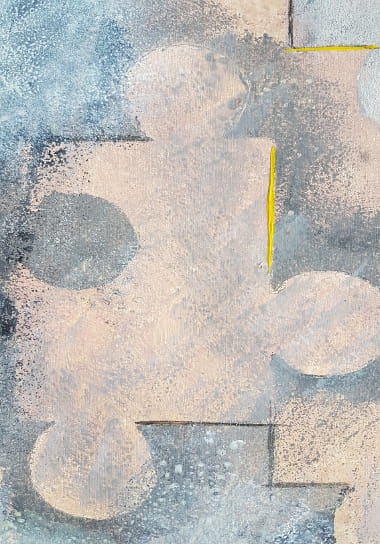
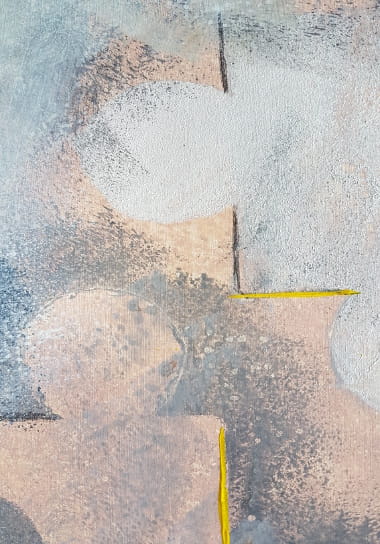
A portrait-orientated archival card measuring 42 x 59.4 cm (16.5 x 23.4“), with a background that sits somewhere between warm white and light grey. Pale, quiet and very soft. The surface is slightly textured throughout. That background took me a long time to do. Layers after layers.
There are no heavy ridges of paint (well, almost), no thick brushstrokes demanding attention. Everything has been blended and feathered with great care, as if the painter wanted nothing to interrupt the feeling.
The painting holds a cluster of interlocking shapes, jigsaw-like, but not mechanical or sharply defined. Their edges are softened, almost blurred, as though they exist somewhere between a solid object and a memory.
Most of the shapes sit together in a loose, rounded grouping. They belong to each other. You can feel it.
Then there’s the one that doesn’t quite fit. It sits slightly apart from the rest. Close, almost touching, but not fully aligned. It carries a faint blush-white tone, very subtle, almost translucent, layered over the shape like the ghost of something. A thin line of gold holds its edge.
And running along two parts of the ones that join inside the cluster, there’s a thin line of gold. Not bold, not decorative. More like a delicate trace that catches light quietly, as if marking the exact place where something was, or almost was.
The upper half of the painting is open space. No objects, no strong marks. Just soft tonal variation in the background, breathing room above the cluster. The composition feels balanced, yet the visual weight sits near the centre. Grounded, but not heavy. Present, but not resolved.
“Still Missing One Piece, No. 1” is an abstract acrylic painting. The first in a series carrying the same title. It’s built around jigsaw-inspired shapes, but not in a way you might expect. There’s a recognisable puzzle here, but no neat grid, no cheerful picture coming together.
Instead, the shapes feel suspended. Some close to connecting, some drifting apart. All of them suggesting a picture that’s not quite complete.
The colours are deliberate. The composition is not accidental. Every element in the painting is there to carry a single, specific feeling: the quiet ache of something unresolved. Something you left behind a long time ago that you have not entirely stopped looking for.
For me, that feeling is deeply personal. Many years ago, I left a piece of myself somewhere, I know exactly where. A moment, a memory, a part of who I was. And I’m still, in some quiet corner of my mind, looking for it. Not with urgency. Not with pain. Just with that same gentle, persistent awareness that something is not yet whole.
The painting doesn’t explain that story. It doesn’t need to. What it does is hold the feeling. Still, honest and open so that anyone who has ever sat with their own missing piece can find something of themselves in it.
Your Missing Piece
This painting is the first in a series. Each one that follows will carry the same title, Still Missing One Piece, but tell a different story. A different memory. A different fragment of a life examined honestly. The same ongoing search.
Before you go, I want to leave you with a question, not about art, but about yourself.
If your missing piece had a shape, what would it look like?
If it had a colour, what would that be?
You don’t need to answer out loud. But I think most of us, if we sit quietly for a moment, already know what we’re looking for.
I’d love to hear your thoughts whether about the painting, the feeling or your own missing piece.
The Story Continues
This is Part 1 of a four-part series exploring what a missing puzzle piece can teach us – about psychology, about searching and about life itself. The story continues here:
Part 2: Jigsaw Puzzle Psychology: Why Some Pieces Stay With Us Forever. Why we can never quite let go of the pieces that got away?
A note from the author:
Missing pieces come in many forms; some of them carry very real pain. If this post touched something difficult for you, please do not carry it alone. Speaking with someone you trust or with a qualified professional is always a sign of strength rather than weakness.


11 March 2026 @ 5:00 pm
A 10,000-piece puzzle – that is quite the puzzle!
My biggest missing piece came when my father killed himself at the age of 47. I was 25 at the time and well into my own recovery, but I remember clearly feeling the finality of what he had done. There would never be any recovery on his part, and there would never again be the possibility of a better relationship with him. Although he was already out of our lives for the most part, there was always that little bit of hope. No more…. I occasionally think about that missing piece and wonder how things might have been different had he lived, but as stated, it would forever remain a missing piece.
I liked the blending of the puzzle pieces. Instead of a sharp edge with nothing in the missing piece space it is blurred, indicating that it has some memory or hint of what the missing piece should be. That is like my example about – although he is gone, there is the memory of what was, and maybe should or could have been. Like you said, it holds and honors the feelings.
When you asked about what the shape of our piece would be, I thought that mine would change, depending on my state of mind at the time. Sharp and spiky at times when I feel cheated, smooth and gentle when I am feeling empathetic, gentle, and grateful – not for his death, but for my own recovery and the road that I took, so unlike his. Colors too, would reflect the feelings at the time.
A great piece, Suhail! That is the art and the blog post.
12 March 2026 @ 11:05 am
Thank you for trusting this post and this space with something so personal and so significant. What you have shared takes real courage and I am genuinely moved that the writing reached you in the way it did.
What you describe is one of the most painful kinds of missing piece there is. Not just a loss, but the closing of a door that could never now be opened. The end of possibility. That particular grief, the loss of what might have been, alongside the loss of what was, is something very few people speak about honestly. You have described it with extraordinary clarity and honesty.
What you said about the blurred edges in the painting stopped me. You understood immediately and instinctively, exactly what those softened outlines were trying to hold, the memory of what was there, the hint of what could have been, the refusal to let the gap be simply empty. That is a more precise reading of the painting than I could have written myself. You felt it directly, without translation. That is everything I hope for when someone looks at this work.
And your observation about the shape of your missing piece, that it changes depending on your state of mind, is deeply perceptive. Sharp and spiky when you feel cheated. Smooth and gentle when you feel empathetic and grateful. That is not just a response to a blog post. That is a profound piece of self-knowledge. It also says something true about all missing pieces, I think that they are not fixed objects. They are living things. They shift with us as we move through time and feeling.
It still surprises me, if I am honest, how such a simple missing jigsaw piece can carry. This is a short post and yet the humble jigsaw puzzle, something most of us have sat with on a quiet afternoon, opens a door to some of the most profound experiences a person can have.
Loss. Hope. The end of possibility. The memory of what was and what might have been. It is one of the things I find most remarkable about the small, ordinary things in life that they are rarely as small or as ordinary as they appear. They are waiting, quietly and patiently, to be looked at a little more closely. And when we do look closely, we find that they have been holding some of our biggest questions all along. A jigsaw puzzle. A missing piece. An entire human life contained in the gap.
Thank you, Don, for reading so generously and so deeply. And thank you, most of all, for sharing your own missing piece here.