

How Can I Learn To Actually See Abstract Art
How can I learn to actually see abstract art is a popular question from so many people who are becoming interested in abstract art. Many people realise that abstract art is beyond what is on the surface. With that in mind, how can I learn to actually see abstract art?
According to the Slow Art Movement, which is popular worldwide, museum visitors often move through museums quickly between artworks. The average is 17 seconds of looking at an individual artwork – resulting in missing a lot of the artworks at the museum.
The Slow Look
Looking at the artwork for a long period of time is absolutely necessary if you are really interested in art. In the museum world, this is commonly known as the “slow look” where viewers spend a long time looking at a piece of artwork.
The “Slow Look” is all about closely observing detail over a period of time to move beyond a first impression and create a deeper experience with the artwork. Close attention to the elements of the artwork, e.g. colours, shapes, lines, texture and composition can produce active cognitive opportunities for meaning-making and critical feeling that may not be possible through a cursory glance of the artwork.
When you focus your eyes on a piece of artwork for a while, you become more aware of the individual different elements of the artwork and how collectively make up the piece of art. Colours, shapes, lines, etc. have particular effects on our moods which, in turn, can evoke emotions and feelings so personal to the viewer.
The “Slow Look” is the art of learning through observation and it can be applied to almost anything else – it does not have to be in an art museum. As you look and continue to look at the artwork for a longer period of time, it helps to gradually let your senses begin to discover other potential deeper connections with the artwork. Begin to allow your feelings to communicate the transmitted emotions from the artwork. Many people who experience this type of communication for the first time, find it absolutely amazing to begin to know another meaning of communication – communication with feelings.
Slow looking is not about the artist, his/her background or the history of the artwork – it is simply about you and the piece of artwork only. To truly appreciate the artwork, I always recommend people not to look, initially, for other information about the artwork, which may influence your approach to it. I have tried it myself several times.
Discover Your Feelings Through Art
Just you and the artwork – and no other information to influence your discovery of your feelings. I deliberately avoid finding out who the artist is, their background, the title of the artwork or any other information, at first. I would allow as much time as possible just to be with the artwork and make a connection.
Slow-looking will even work better if you can manage to switch off the logical curious mind and let your feeling take over to explore and create a sincere connection with the world around us. It is at this moment that you will begin to see another meaning and definition of the tremendous beauty that surrounds us. It really can open our eyes to appreciate more what we may have overlooked all the time.
Let me explain.
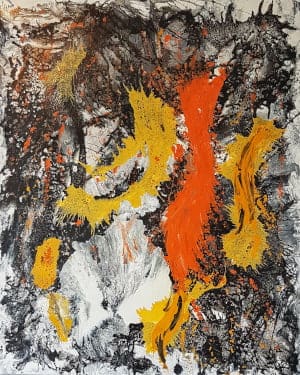
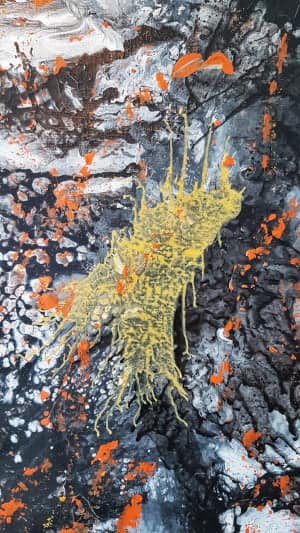
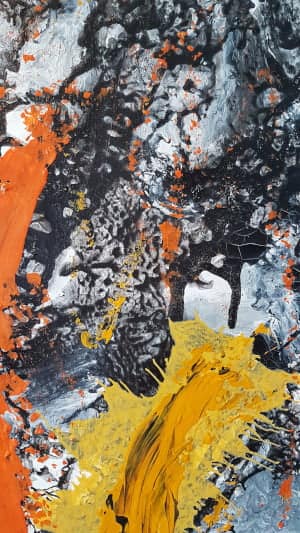
The three images shown here are from one of my acrylic abstract paintings (title: Makes No Sense). The top image shows the full painting measuring 81 x 101 x 1.5 cm (32″ x 40″ x 0.75″). The other two images are closeups of a couple of sections of the main painting. You can see the difference between the three images and the different effects. I am sure you can see my point and that is how the slow look works.
Connecting with Art
The key here is whether you actually make a connection with the artwork, or not. Art is the language of feelings and sometimes it may take a while to make that connection, if ever.
Some people refer to it as pictorial intelligence. Pictorial intelligence is when a piece of artwork reveals itself to you bit by bit. This is a magic moment. When you find yourself beginning to see your feelings. It is just amazing.
My personal experience
I’m well aware of this connection every time I create a painting. From my experience, it could take hours, days or even weeks before I make that connection with the painting. But once connected, the painting develops in a greater harmony all the way through to the end.
I spend a great deal of my time looking at and closely observing sections of my paintings and then the complete painting. I repeat this process regularly and almost every time I do this exercise, I discover something new, something I have not seen before in the very same painting.
Another habit that I also do is looking again at my old paintings. And, yes, that triggers a similar feeling as if I am seeing it for the first time, discovering new meaning and maybe a new story.
Every time it happens, I am conscious that I am either seeing with my feelings or actually seeing my feelings.
The language of feelings can be challenging to some, but all you need to do is just allow the artwork to draw you to it and pull an emotional response from within. Once you make that connection that keeps you drawn in, it is then that you know you are linking your feelings to something so special. Try your best not to think about whatever grabs your attention, just let your feelings take over and let go. Just let go of any thought process. Switch off your logical mind.
This is when you will be discovering the true beauty of the artwork the way you want.
The Familiar vs. The Unfamiliar
Obviously, the term visual art refers to seeing a piece of artwork, i.e. we are using our vision sensory system. When we look at any object, we also engage our minds uncontrollably. The mind will immediately attempt to identify the object as something “familiar”, something that the mind can recognise.
At the same time, our feelings become involved in attempting a similar approach to that of the mind, i.e. finding a “familiar” feeling that we experienced before.
The challenge here is that at no stage in life, we are taught or learned how to use our feelings in recognising and interpreting exactly what we “see” using our feelings, not just our minds.
“The abstraction is often the most definite form for the intangible thing in myself that I can clarify in paint.” – Georgia O’Keeffe
Visual art is a fantastic expressive language that attempts at all times to evoke emotions. Emotions can only be interpreted by our feelings before our minds.
Bear with me for a moment.
To “feel” a piece of artwork means you have to engage your feelings not your mind.
One of the ways to do that is to look at the artwork and keep looking at each element of the artwork individually, i.e. all the shapes, lines, colours, textures. Take a step back and look at the entire artwork with all its elements together. Give yourself more time until your mind concludes whether it can or cannot interpret the artwork.
It is at that time (most likely) that you will begin to engage your feelings much more than your logical mind. Slow looking is very much needed when looking at abstract art. This is one of the reasons you see almost all artists spend a great deal of time looking at their abstract art during and after it’s completed.
Once you make that change between mind and feelings, you will begin to establish a connection with the artwork and the feeling it gives you. The more you look at the artwork, the stronger the connection and the feeling.
Using the concept of the slow art movement and the slow look can help us in various other activities in our lives.
You may find the following articles of interest:


