From a Distance: An Abstract Painting About Memory and Perspective
What becomes visible when time gives us enough distance.
There is a particular moment that sometimes happens when you are walking in the hills. You have been climbing for a while, head down, watching your footing and aware only of the ground immediately ahead and the effort in your legs.
Then, without quite intending to, you stop and turn around. And there it is: the whole landscape spread out below you, suddenly visible in its entirety. The valley you walked through. The road that seemed so long and winding from inside it, tiny now but perfectly clear.
You think: so that is what it looked like. So that is its shape. You could not see it from inside. You had to climb away from it first.
That is what understanding can feel like when it arrives through time and distance. Not a sudden insight. Not a conversation that unlocks everything. Simply the gradual accumulation of years, of living and moving forward, of climbing without knowing you were climbing, until one day you turn around and the whole shape of something is finally, quietly visible.
From a Distance is the fourth painting in Oblivious and Untold, a five-part abstract painting series. The series explores how difficult events change as time, memory and perspective gradually alter the way we carry them.
What distance reveals
This is the fourth painting in the series and it is the first one where something opens. After The Cut, Inward and The Long Road, this is the painting where the palette begins to breathe again.
The blue-grey of distance and the returning warmth of warm colour begin to come forward. Not because the thing that happened has changed, it has not, but because you have moved far enough away from it to finally see it whole.
What distance reveals, more than anything else, is proportion.
When you are close to something painful, when it has just happened or when you are deep in the middle of carrying it, it fills your entire field of vision. It is all you can see. There is no context around it, no perspective, no sense of where it sits within the larger landscape of your life.
It simply looms: heavy, close and unresolved.
Then, slowly, as the years accumulate and the distance grows, it begins to find its proper size. Not smaller, exactly. The thing that happened was real and its impact was real. But it becomes proportionate. One part of a larger picture. One stretch of a road that turned out to go much further than you could see from where you were standing.
That shift in perspective is what I tried to place inside this painting.
Compassion after pain
Distance also does something unexpected. It brings a kind of compassion that closeness makes impossible.
When you are still raw from the original cut, still deep in the withdrawal or the long carrying, it is very hard to see the other person, the one who caused it, with any generosity. How could you? You are too close to what they did, what they failed to do and what they failed to understand.
But from far enough away, something shifts.
You begin to see them not as the single defining figure of a painful moment, but as a whole person: limited, unknowing and moving through their own life without any awareness of the mark they left in yours.
They were not oblivious because they did not care. They were oblivious because they were human. And humans, all of us, cannot always see what we leave behind.
This does not excuse the impact. It does not undo the carrying or shorten the long road. But it changes the weight of it, very slightly and very importantly.
To understand, even, partially and imperfectly, is to put something down that you have been holding for a very long time. Not all of it. But enough to feel the difference in your hands.

The painting
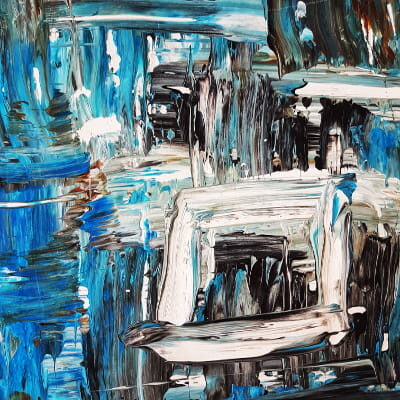
The painting feels like an old memory fading at the edges: vivid in fragments, but impossible to hold as a whole.
The surface is dense and restless, built from dragged and interrupted marks that suggest fragments of rooms, windows and half-remembered structures. Just like fading memories, nothing remains fully defined.
Pale shapes emerge and disappear within the heavier marks, like images recalled only in flashes: a doorway, a reflection, the outline of a familiar place seen after many years.
The layers seem to overlap rather than settle, creating a space where present and past are continually meeting and dissolving.
It does not resolve into a single scene, because memory rarely does. Instead, it holds on to atmosphere: the feeling of having once been somewhere, of recognising something without being able to name it.
And within the turbulence, small areas of brightness remain. They are fragments the mind has protected, even as everything around them begins to fade.
Memory in layers
The painting was not intended to describe one particular place or memory. Instead, it emerged through the gradual layering and interruption of colour.
The darker and heavier marks hold the density of what could not be understood at the time. The blue-grey areas suggest distance and the cool clarity that comes with looking back. The warmer colours are not a return to the past, but signs of something that has survived it.
The forms remain uncertain because memory is uncertain. We often remember the atmosphere of an experience more clearly than its exact details: the feeling of entering a room, the tone of a voice, the quality of light or the sense that something important was happening just beyond our understanding.
For me, abstraction offers a way of holding those impressions without forcing them into a fixed narrative. The painting does not provide a single answer. It allows the past and the present to remain visible at the same time.
A question for the viewer
Is there something in your own life that looked entirely different once you had enough distance from it?
A moment, a person or a period you could not make sense of while you were inside it, but which revealed its true shape when you were finally far enough away to turn around and look?
What did you see that you could not have seen before?
One more painting and post will follow to complete Oblivious and Untold abstract painting series. You can read the earlier reflections, The Cut, Inward and The Long Road to give you a better picture of the series.
You can also explore the earlier series Between Two Points and Missing Puzzle Piece.