
Qi in Motion: Capturing Life’s Vitality Through Chinese Ink Wash Painting and Abstract Art
As an abstract artist, I find myself drawn to the power of simplicity and the ability to convey emotion through colours and minimalist compositions.
This is why I’m captivated by the ancient Chinese ink wash painting tradition. Although these art forms seem worlds apart, I believe they share some fascinating connections that have enriched my creative journey.
I’m also interested in the dreaming stories and dot painting techniques of Australian Aboriginal art, the vibrant colours and patterns found in traditional African art, the intricate geometries of Islamic art and the deep spirituality infused in the indigenous art of the Americas.
I will write separate blog posts about each of these unique art forms.
I’ve written briefly about Chinese ink wash painting in my blog “Abstract Painting and Chinese Brush Painting” as well.
However, in this blog post, I want to focus on the connections between abstract art and Chinese ink wash painting.
Despite their distinct histories and cultural roots, I believe these two art forms share some thought-provoking commonalities that have inspired my own creative exploration.
The Tao of Painting
Chinese ink wash painting draws its inspiration from the ancient principles of Taoism. At the heart of this philosophy lies a deep appreciation for simplicity, naturalness and harmony with the natural world.
These Taoist values are beautifully reflected in the minimalist compositions and the reverence for negative space that characterises ink wash paintings.
The sparse brushstrokes and empty spaces are not just aesthetic choices, but rather a reflection of a worldview that celebrates the beauty in simplicity and embraces the essence of nature.
(Abstract minimalist art is a beautiful style of art but extremely challenging. Check out my blog: Less is More: The Beauty of Simplicity in Abstract Minimalism Art).
Take, for example, the classic work “Bamboo and Rock” by the 16th-century artist Wen Zhengming. With just a few brushstrokes, Wen captures the essence of the bamboo’s graceful curves and the rock’s rugged textures.
The negative space isn’t just an empty void; it’s an integral part of the composition, allowing the viewer’s imagination to fill in the gaps.
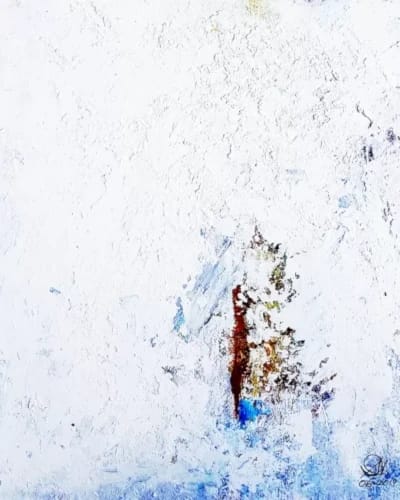
Similarly, in my abstract painting “Essence of Calm,” I used simple organic shapes and a muted colour palette to evoke a sense of tranquillity and stillness.
The empty spaces between the shapes encourage the viewer to pause and reflect, much like the negative space in ink wash paintings.
Taoism: The Way of Nature
Chinese ink wash painting is inspired by old Taoist ideas. Taoism teaches people to value simplicity, being natural and living in harmony with nature.
These beliefs can be seen in the simple style and use of empty space in Chinese ink wash paintings. The few brushstrokes and open areas are not just for looks, they show a way of thinking that finds beauty in simplicity and tries to capture the true spirit of nature.
Qi: The Life Force
In traditional Chinese philosophy, “Qi” (pronounced “chee”) refers to the vital life force or energy that flows through all living things.
It is believed that this universal energy permeates everything in the natural world, creating a sense of interconnectedness and harmony.
In the context of Chinese ink wash painting, capturing the essence or spirit of a subject is often associated with depicting its Qi – its unique life force or energy.
The artist’s goal is not to create a photorealistic rendering but rather to evoke the feeling and emotion of the subject through a minimalist interpretation that captures its Qi.
This concept resonates deeply with me in my abstract work. I strive to distil the essence of emotions, experiences or natural phenomena into compositions that evoke a visceral response in the viewer.
Just as ink wash painters seek to capture the Qi of their subjects, I aim to infuse my paintings with a sense of energy and vitality that transcends the physical representation.
A Meditative Practice: The Literati Tradition
In the tradition of Chinese ink wash painting, true mastery lies not just in technical skill but in the ability to imbue one’s work with profound philosophical meaning and personal expression.
This epitomised the approach of the literati artists – scholars who were well-versed in poetry, calligraphy, and the classics.
These literati artists were not merely painters but artistic visionaries who drew upon their deep knowledge of literature, history, and philosophy to create works that transcended pure aesthetics.
One of the most famous literati artists was Bada Shanren, whose ink wash painting “Lotus and Ducks” is a masterpiece of symbolism and poetic expression.
The lotus flowers represent purity and divine harmony, while the ducks symbolise fidelity and love.
Bada Shanren’s work invites the viewer to embark on a journey of contemplation and self-reflection, revealing layers of meaning with each viewing.
In all my abstract paintings, I always aim to create a similar sense of depth and introspection.
Using a combination of bold brushstrokes and delicate washes, I seek to capture the complexities of the human experience, inviting viewers to interpret the work through their own personal lens.
Just as the literati artists drew inspiration from their vast knowledge, I too strive to imbue my paintings with personal experiences and philosophical musings, creating works that resonate on both an aesthetic and intellectual level.
Negative Space as a Positive Force
Both Chinese ink-wash painting and abstract art share a reverence for negative space.
In ink wash paintings, the negative space is often as important as the brushstrokes themselves, allowing the viewer’s imagination to fill in the gaps and interpret the work through their own lens.
One of the most striking examples of this is the ink wash painting “Dwelling in the Qingbian Mountains” by Wang Meng.
The negative space around the mountains and trees creates a sense of depth and vastness, inviting the viewer to imagine themselves within the serene landscape.
In my abstract painting “Spatial Harmony,” I used negative space to create a sense of balance and tension.
The arrangement of shapes and colours guides the viewer’s eye through the composition, allowing the negative space to breathe and enhance the overall impact of the work.
Capturing the Essence
Perhaps the most profound connection between these two art forms lies in their shared pursuit of capturing the essence or spirit of a subject, rather than merely representing its physical form.
Look at “On a Mountain Path in Spring” by Ma Yuan. This 1200 AD exquisite ink on silk painting is a masterful example. With just a few brushstrokes, Ma Yuan captures the delicate beauty of simplicity and spirituality, inviting the viewer to connect with the deeper emotions and symbolism of the work.
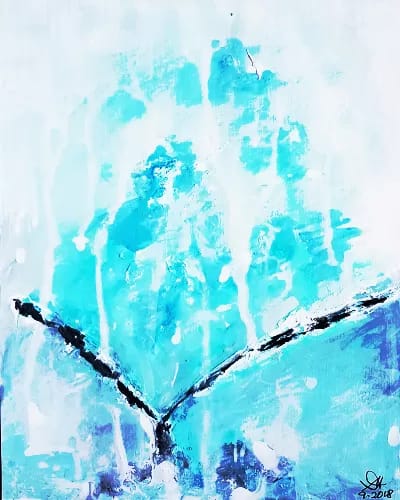
In my abstract painting “Essence of Joy,” I aimed to distil the feeling of pure, unbridled happiness into a vibrant, energetic composition. Using bold colours and gestural brushstrokes, I sought to evoke the emotion of joy itself, rather than simply depicting a joyful scene.
Personal Reflection on Negative Space in Abstract Art
As an abstract artist, I find the use of negative space to be a powerful and often underrated tool in my creative process.
It’s not just the absence of elements but an active force that can create tension, balance and depth within a composition.
Negative space allows the viewer’s eye to rest and the mind to wander, inviting them to fill in the gaps with their own interpretations and emotions.
It’s a reminder that what is left unsaid can sometimes be more profound than what is overtly stated.
In my work, I strive to treat negative space as a vital component, allowing it to breathe, flow and guide the viewer’s experience.
It’s Your Turn: Experiment with Negative Space
One simple exercise to explore the power of negative space is to start with a plain canvas or sheet of paper and place a few simple shapes or forms in different arrangements.
Observe how the negative space shifts and changes, creating new shapes, lines and implied movements.
Experiment with varying the sizes, colours and placements of these forms to see how the negative space responds and transforms the overall composition.
Alternatively, you could start with a more complex abstract work and then selectively remove elements, allowing the negative space to take on a more prominent role.
The key is to approach negative space as an active, intentional element, rather than mere background.
Books You May Find Interesting
Here is a small list of books that illustrate and explain the depth of Chinese ink wash paintings:
- “The Spirit of the Brus” by Sungsook Hong Setton
- “Zen Painting” by Yasuichi Awakawa
- “The Ch’i of the Brush: Capturing the Spirit of Nature with Chinese Brush Painting Techniques” by Nan Rae
- “Longing for Nature: Reading Landscapes in Chinese Art” by Kim Karlsson
Chinese Ink Wash Painting: A Meditative and Spiritual Journey
Beyond the technical and aesthetic connections, both Chinese ink wash painting and abstract art offer a meditative and spiritual dimension to the creative process.
In the tradition of Chinese ink wash painting, the artist is encouraged to cultivate a state of mindfulness and presence, allowing the brush to become an extension of their inner self.
Similarly, when I approach my abstract works, I strive to quiet my mind and tap into a deeper well of creativity and self-expression.
The act of painting becomes a form of meditation, allowing me to connect with my innermost thoughts and emotions.
As I continue to explore and experiment with abstract art, I find myself drawn to the rich history and philosophy of Chinese ink wash painting.
By embracing some of the shared principles of negative space and essence, while also appreciating the unique techniques and spiritual underpinnings of this ancient art form, I hope to deepen my own creative practice and offer a fresh perspective to my audience.
I’d love to hear your thoughts and perspectives on these connections between abstract art and Chinese ink wash painting.
Please feel free to share your comments and feedback below.
Other Related Articles
Creating Art is a Journey of Self-discovery


4 July 2025 @ 2:08 am
Thanks for the interesting read, Suhail!
As I was reading, I kept thinking about how all artists who create art, for something more than just creating pretty pictures, keep hitting on the same notions. That there is a meditative and spiritual aspect to it all. Something that connects them to a whole new deeper world. I was reminded of my book called Threads of the Spirit where I made note of 100 things that those traveling the spiritual journey couldn’t help but learn. I saw the connection in so many of the books I read over the years. What I am saying, in relation to art, is that artists who take the journey seriously and follow where it leads, can’t help but experience those things, those discoveries, in their art. I see it too, in all your blog posts that I have read so far.
4 July 2025 @ 10:42 am
You’re absolutely spot on, Don, “there is a meditative and spiritual aspect to it all.” Most abstract artists and others I’ve read about and still read about, make their art from deep inside themselves. Their work is almost like a true mirror of who they are, and through their art, they share their life’s journey. Maybe that’s why their art still means something, even long after they’re gone.
It’s in those special moments when someone else can look at a piece and discover the story behind it or even the story of the artist. But you can only do that if you look past how it looks on the surface.
It’s even more impressive when just a few brushstrokes in a Chinese ink painting can carry so much meaning and feeling. It’s definitely not just about making something that looks pretty.
That’s what makes a real difference between art that’s just there to match the sofa and art that has its own statement and that could change almost everything around it.
It reminds me of a time when someone wanted to buy three of my paintings for a very good price. But then he and his wife made a mistake saying, “These would look perfect with our décor.” They didn’t understand why I rejected the offer, even after I tried to explain that my paintings aren’t just decorations.
Don’t get me wrong, decorative art and pretty pictures can still catch our eye and make us happy. They have their own purpose, but it’s a very different one. We all like to have beautiful things around us, whether that beauty is on the surface or something deeper. But not all art has the same kind of intrinsic value.
I think writers go on a similar journey. The difference is, writers tell their stories with words, and painters tell theirs with paint. But I imagine the path is much the same.
Thanks so much, Don, for reading the blog and leaving your comment.
4 July 2025 @ 3:19 pm
Thanks Suhail!
With regards to writers experiencing something similar, I totally agree. As in art, something of the writer always remains part of the material too. Even if it is a work of fiction one can pick up traces of their essence within the pages. Well, that’s my take on it anyway.
4 July 2025 @ 3:25 pm
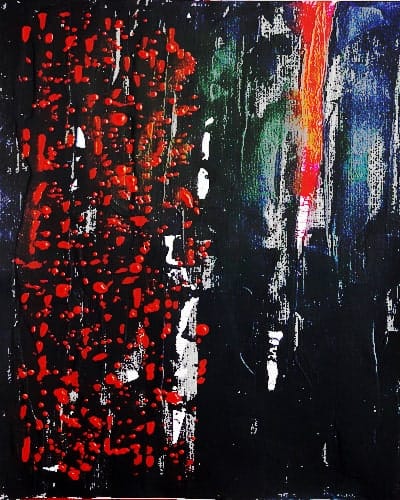
I wanted to comment on your Essence of Joy painting. I love the look of it! It reminds me of Asemic art, in that the red drips/splotches on the left side reminds me of writing, perhaps a poem or story about that essence, and what is in the background.
4 July 2025 @ 9:28 pm
Hello again, Don.
We’ve often talked about how difficult it can be to look deep inside ourselves. It can feel dark, not because it’s bad, but because it’s unknown. As you move through unknown layers, you come across various memories, images and other stored details that can feel confusing.
As you continue moving forward from the quiet, dark background through the narrow streaks of white light, you begin to see the red marks standing out boldly and catching your eye. They look almost like a secret code or a burst of energy. To me, they represent moments of contentment, the essence of joy. They remind you that joy can be found even in the darkest places.
Red demands attention. It has the longest wavelength within the visible spectrum. Similarly, joy can shine through even when things are dark.
I know this might sound too philosophical, but this is how art can take a different level of meaning, at least in my opinion.
This is why it can be hard to explain some of my paintings to others. I can easily explain it, but how many will truly appreciate such a description?
Thank you, Don and I appreciate your comments.
4 July 2025 @ 10:23 pm
Wonderfully said and painted!
It is not too philosophical for me, I totally get it. For me, this true art, in the sense that the artist opens a dialog with his/her art and that dialog is felt by others who take time to notice. Perhaps the viewer does not see exactly what the artist has intended, or the art itself has intended, but it does speak.
I appreciate when you tell the story of your pieces. That seems to allow another, like me, to really connect on another level.
Perhaps you noticed a thread in the artist forum “Evoking the Clay Memory” by Faik AL-ABOUDI. He did what you did here, sharing the true depth of the work. Like your work here, I feel/felt privileged to hear about the journey of the artist and his artwork.
6 July 2025 @ 11:51 am
Thank you, Don.
Yes, I completely agree. When artists talk about their work, it opens a dialogue connecting viewers with the art. Keen art enthusiasts enjoy hearing from the artists and learning more about both the artwork and the artist.
This adds another way to appreciate the art. It stops the piece from feeling like just a lifeless object hanging on the wall.